The Man Who Wrote the Perfect Novel Review
Why Write a Novel About Abraham Lincoln'southward Killer?
Karen Joy Fowler's Berth isn't so sure it should be—until information technology settles on a radical twist for our times.
Slate has relationships with diverse online retailers. If you purchase something through our links, Slate may earn an affiliate commission. We update links when possible, but note that deals can elapse and all prices are subject to alter. All prices were upward to date at the time of publication.
Writing historical fiction can mean spending a lot of time in the heads of people who do or believe awful things, by contemporary standards. It's difficult to write sympathetically about a grapheme from the afar past without feeling that y'all are in some way endorsing aspects of the historic period: its bias, its brutality, its inequity. 1 way to get around that is to tell the untold stories of those who lived on the margins—the victims of that inequity and the objects of that bias. Merely what if the story you lot're telling is the villain's?
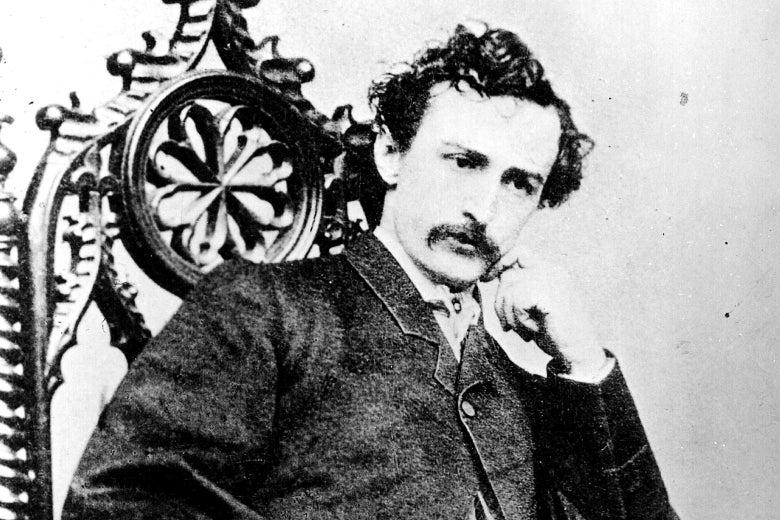
From the first page of her new novel Booth , the talented and ambitious Karen Joy Fowler betrays her anxiety nearly the job she's set herself. She writes in a nervous author's note that an interest in the experiences of the families of mass shooters led her to John Wilkes Booth, which immediately presented a trouble. "I did not want to write a book virtually John Wilkes Booth. This is a man who craved attention and has gotten too much of it; I didn't think he deserved mine." The note mentions many of the crises of the by few years—those mass shootings, Trump's election, the uprising of Jan. half dozen, 2021—among which Fowler seems to express doubt, in the opening paragraphs of her own book, about whether the book ought to exist at all. She writes, "The tension over this result—how to write the book without centering John Wilkes—is something I grappled with on nearly every page." That grappling leaves a mark.
For virtually iv decades, Fowler has written restlessly beyond genre and fashion, from her offset novel Sarah Canary—a borderland tale with a sci-fi twist—to her World Fantasy Award–winning story collections to the literary-pop pleasures of her 2004 bestseller The Jane Austen Book Gild. Her almost contempo novel, 2013's Booker-shortlisted We Are All Completely Beside Ourselves, told a politically engaged family story that, in an unforgettable twist a tertiary of the way through the volume, reveals itself as an entirely dissimilar kind of tale. In each of these books, she's shown herself to be a writer who uses the conventions of genre when they conform her—and who is unafraid to invent new ones when they don't.
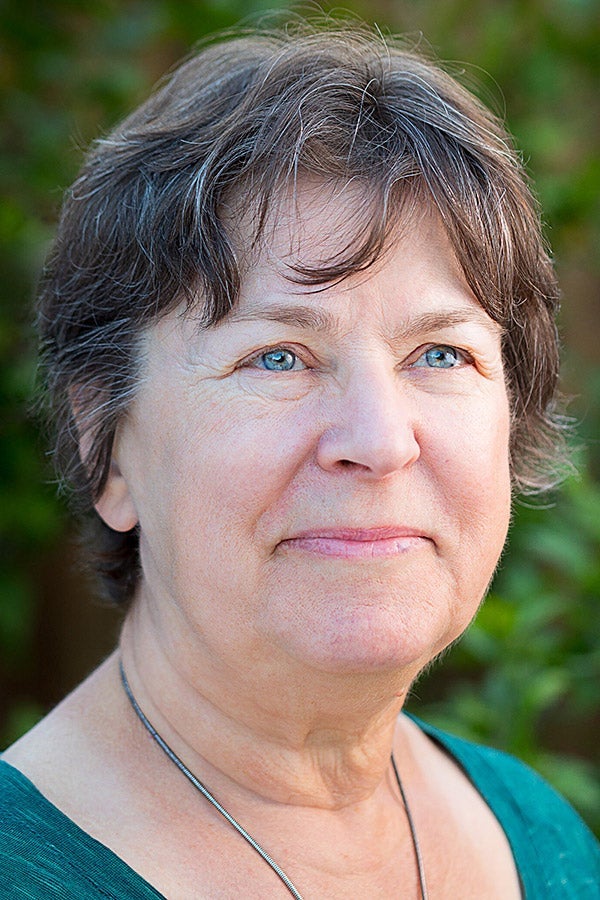
In Booth, Fowler addresses the outcome of writing a historical novel nigh a historical bad guy in an innovative way. She doesn't simply aggrandize her novel'due south palette, telling the decades-spanning story of the entire Booth family, a clan in which John is 1 amidst many until the fateful moment he makes himself the family's—and the nation's—villain. She makes the audacious decision to bring a historian'southward corrective and contextual voice to her historical fiction, pulling the reader out of the xixthursday century over and over to provide a 21st century perspective on the attitudes and actions of her characters. This makes a bit of a mess of the novel, but also serves equally an intriguing new bending at a problem that's likely to vex historical fiction writers for decades to come.
John Wilkes Booth is built-in in 1838, the son of one of the era's most famous phase actors, Junius Brutus Booth, and the 9th of ten children. The Booths are a stage family, one in which "the whole subcontract speaks in iambic pentameter" when someone's trying to acquire lines. I son or another is ever accompanying their begetter around the theaters of the East Coast, attempting to keep him sober enough to perform. On those rare occasions when Junius is domicile at the family unit's subcontract outside Baltimore, his personality dominates the family. "Dinner with Father is a one-human evidence," Fowler writes. His declarations that the theater ought to be no place for his children, for whom he harbors heart-course dreams, are "much less persuasive than the glamour he casts with every word, every gesture."
As the children grow older, they launch careers and families of their ain; many of those sons will become actors themselves, of various levels of success. (One, Edwin, will get a star; famous for his Hamlet, he performed into the 1890s.) Oftentimes they merely know what is happening in 1 some other's lives considering those lives brand the newspapers. "Ane of the peculiarities of the Booth family," Fowler writes, "is how oft they communicate via article and review." Over the years the bonds betwixt them stretch and occasionally break; this is, after all, a family of passionate orators, wont to ignite in contend when in the same room. Fowler'due south narrator roves among the children, settling for some time on sincere young Edwin, trying to keep his father in line, and then landing on flighty daughter Asia, whose loyalty to family unit higher up all comes to haunt her.
Near compelling of all is the graphic symbol Fowler had to well-nigh completely invent: Rosalie, 15 years older than John, most whom well-nigh nothing appears in the written record. Fowler makes her watchful, resentful, a duckling who never gets the chance to turn into a swan. "No girl knows she's ugly until someone tells her then," Fowler writes, "and every ugly girl remembers the someone who first told her." For Rosalie it'southward a neighbor, overheard expressing her sympathy for Rosalie'southward beautiful female parent, to accept a child similar that. Rosalie is a lost soul, separated from her younger siblings by a yearslong gulf that coincides with the Booth children about her age, who all died young. Aptitude by scoliosis and consigned to her aging mother'due south side, Rosalie sees her chances at love evaporate, her hopes quashed by fortune and tradition.
There's nothing modernistic about Rosalie. For the almost part, readers instinctively sympathize the means her life might have been different had she been built-in in a unlike era. That's 1 mode historical fiction has traditionally dealt with the gulf betwixt the expectations of today and the reality of the past; the author writes to make the states feel we are "really there," but trusts that our contemporary perspective will color the tale. But Fowler feels this kind of unspoken assumption isn't enough. Booth may be set in the 19th century, merely information technology'south telling its story from the 21st. Fowler's narrator takes the x,000-foot view of her story, offering context, correction, and complication to her characters from her perch in the nowadays. When patriarch Junius Berth praises the late President Andrew Jackson, the narrator pops up to inform us that Booth is eliding "the letter he wrote during his onetime friend's presidency, calling him a damned scoundrel and threatening to cut his pharynx every bit he slept." When a free Black neighbor shoots at John and Asia on Halloween night, the Booths protest bitterly—"incapable of understanding," Fowler's narrator points out, "what a blackness homo might experience, living alone in a remote cabin, and seeing a mob of people coming silently towards him in the dark."
The Booths are incapable of agreement, merely we are capable, and the typical historical novel might take that as a given—or at to the lowest degree but advise that annotation through action or dialogue. Fowler does not. She seems determined at every turn to overtly address the circumspection and concern she feels about telling this story, about this family, at this time.
This tin get clunky. The novel occasionally seems to abjure entirely the imaginative leaps of fiction to evangelize nonfiction-style exposition. An aside on the Maryland land song turns into a disquisition on the song's anti-Wedlock sentiments and concludes with the fact that attempts to replace the song have failed equally recently as 2020. Another section, on President Abraham Lincoln'due south 1862 clemency granted to Native American rebels in the Dakota War, feels like an unnecessary case of box-checking, 2 pages of Wikipedia facts shoehorned into the narrative and so that the book tin can't be accused of ignoring this aspect of Lincoln'due south presidency. If this history affected the Berth family or the arc of their story, we're never told.
Fowler makes information technology articulate, in that author's annotation, only how difficult it has been to separate truth from falsehood in researching a family unit equally mythologized as the Booths. Just it isn't only posterity that rewrites the narrative; we are all doing so throughout our lives, equally Fowler's narrator wryly points out equally she explains how Edwin, over his many years, told a lot of unlike stories about his father's first married woman, whom Junius abased in England but who chased the family to the New World. "This is a skilful reminder," Fowler writes, "that no one in the world is a reliable source for their own story."
Ofttimes Fowler does accept advantage of this to deliver slivers of historical data about her characters that perfectly clarify the kinds of people they are, as when Asia natters on about her brothers, John and Edwin, who are taking her on a trip to Niagara Falls. John, the narrator tells us, is accompanying considering he's fled Philadelphia, where he had to pay off a woman who claims he's made her significant. Edwin has the handclapping. "Asia knows none of that," Fowler writes. "She has the most wonderful brothers!"
Booth is at its nigh affecting, though, when information technology's at its most imaginative. The novel'due south climax tells not merely the familiar story of John Wilkes' shooting of Lincoln but the unfamiliar—and, it seems clear, often invented by Fowler—stories of how all his family members receive the news. One by one, Fowler'southward narrator settles in each of these minds, watching them as they absorb the fact that the drama of their lives has been turned into the tragedy of a nation. We land, finally, upon Rosalie, miserable Rosalie, whom we know has had every reason to bemoan all that has come before. But at present she can't remember whatever of that. "How happy, how rich her life once was!" Rosalie thinks. "John has murdered them all."
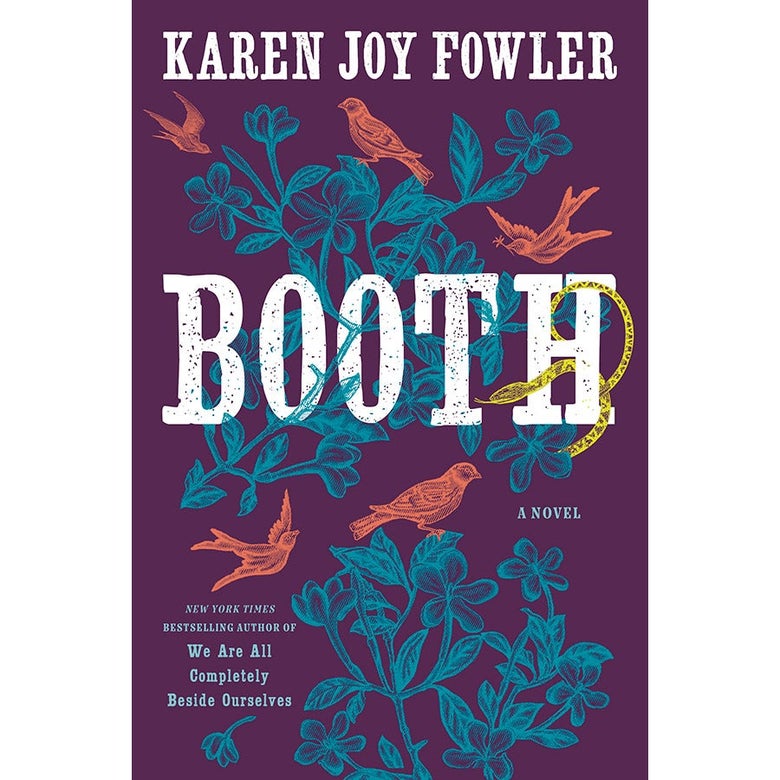
Berth
By Karen Joy Fowler. Putnam.
greshamwitheniand.blogspot.com
Source: https://slate.com/culture/2022/03/karen-joy-fowler-booth-book-review-historical-fiction-lincoln.html
0 Response to "The Man Who Wrote the Perfect Novel Review"
Post a Comment